
Process optimization at the Zillertal mountain dairy: How a Tyrolean family business reduced supply chain costs by 23% despite a shortage of skilled workers
Company profile
The Zillertal mountain dairy in Schlitters is one of the largest privately owned dairies in the Tyrolean Zillertal valley. Founded in 1921 as the Hirschhuber dairy, the family business is now run by Alois Hirschhuber in its fourth generation – since taking over from his father Hans in 1994.
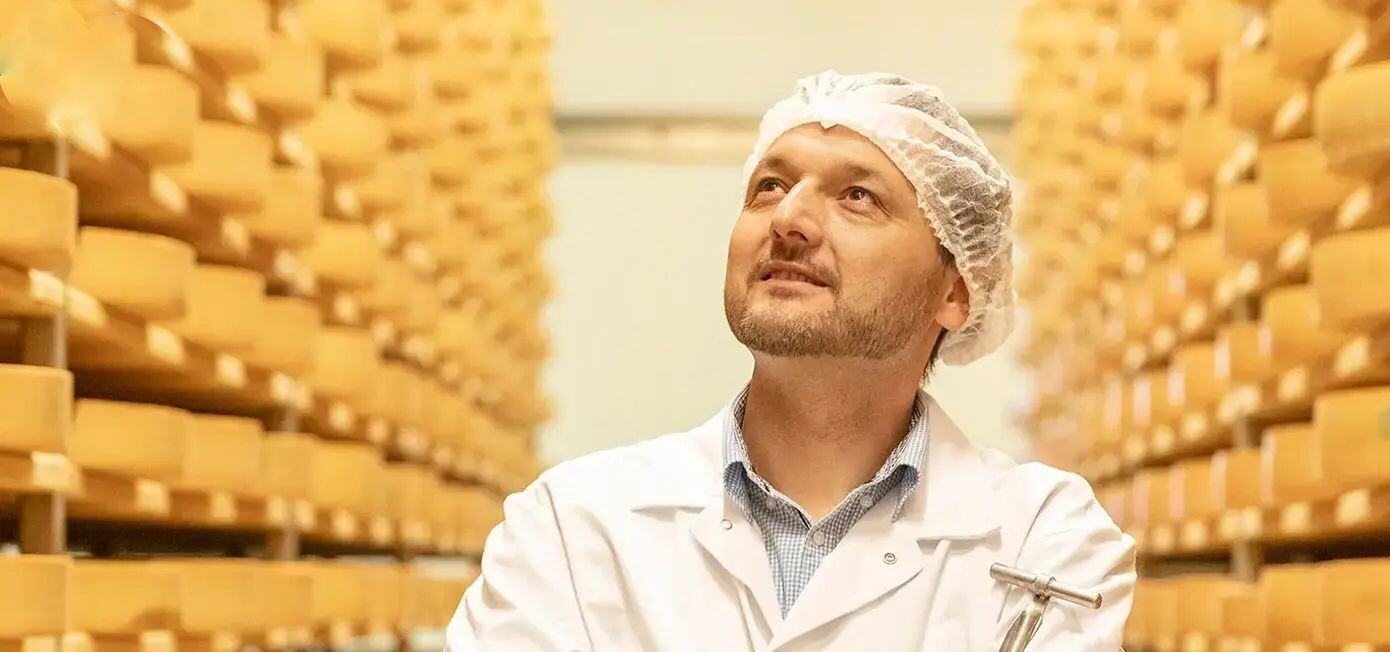
Vertical integration encompasses the entire value chain: Around 180 hay milk farmers from the lower Zillertal valley and the Weerberg-Weer region supply the dairy with 100% silo-free and GMO-free mountain hay milk – some of it from certified organic production. The milk comes from a maximum distance of 30 kilometers, and many suppliers operate mountain farms at altitudes above 800 meters. Around ten employees produce approximately 900 tons of high-quality cheese annually, including mountain cheese and natural Emmental cheese with a maturation period of several months.
Marketing is conducted through three channels: supplying major food retailers in the DACH region (Germany, Austria, Switzerland), a growing online shop with direct shipping to end customers, and a dedicated cheese shop at the production site in Schlitters. This multi-channel structure requires different processes for B2B wholesale customers and D2C end consumers.
Initial situation and problem statement
The Zillertal mountain dairy faced a paradoxical situation: rising demand for authentic Tyrolean mountain cheese coincided with a structural shortage of skilled workers in the rural Zillertal valley. Vacancies in administration and logistics remained unfilled for months. Growth potential remained untapped because administrative capacity was lacking with only ten employees.
The analysis identified significant resource allocation in non-value-adding activities: manual data entry along the supply chain, redundant documentation for hay milk traceability, and time-consuming customer inquiries regarding batches, ingredients, farms of origin, and delivery status. Employees spent a significant portion of their working time searching, making inquiries, and entering duplicate data – time that was then lacking for artisanal cheese production.
Key challenge
The specific requirements of hay milk cheese production increased the complexity:
Dimension 1 – Traceability of hay milk:
Every batch of cheese must be fully traceable from the final product back to the supplying mountain farmer. Hay milk certification, organic certification, and the Food Information Regulation (EU) No 1169/2011 require documented batch tracking along the entire chain – from the 180 suppliers to the refrigerated counter.
Dimension 2 – Quality Assurance:
Laboratory results for milk deliveries, ripening parameters for mountain cheese and Emmental, care protocols, and release processes must be systematically recorded and archived. Traditional craftsmanship – passed down through four generations – clashed with paper-based documentation, resulting in media breaks and time-consuming searches.
Dimension 3 – Multi-Channel Complexity:
B2B customers in the grocery retail sector expect EDI-compatible delivery notes and standardized product data. D2C customers in the online shop require real-time inventory information and shipment tracking. The company's own cheese shop in Schlitters needs flexible order picking for walk-in customers.
Dimension 4 – Seasonality and ripening:
The milk deliveries from the 180 mountain farmers fluctuate seasonally with the alpine farming activities. The ripening time varies depending on the variety, ranging from weeks to several months – mountain cheese and natural Emmental only develop their full flavor after a long maturation period. Production planning must reflect this variability.
Methodical approach
The consulting project followed the SCOReX framework (Supply Chain Optimization & Resource Excellence) in four phases:
Phase 1 – End-to-end process recording:
Documentation of the entire value chain, from the receipt of hay milk at the 180 suppliers to its shipment to end customers. Recording of all process steps, interfaces, data flows, and media breaks. Identification of 47 individual processes in six main areas: raw material management (milk collection, quality control, farmer invoicing), production, ripening, quality assurance, packaging/shipping, and distribution via all three channels.
Phase 2 – Waste Analysis:
Systematic identification of non-value-adding activities according to Lean principles. Quantification of search times, duplicate entries, waiting times, and correction loops. Prioritization based on automation potential and quick-win opportunities – particularly relevant with only ten employees handling both production and administration.
Phase 3 – Process optimization:
Redesign of core processes according to the first-principles approach. Elimination of redundant data entry steps, standardization of workflows, definition of automation potential. Development of an integrated data model for seamless batch information – from the mountain farm to the cheese dairy and on to the customer.
Phase 4 – Requirements specification and ERP recommendation:
Creation of a structured requirements specification with 156 weighted requirements. Specification of industry-specific functions: milk payment processing for 180 suppliers, hay milk certification, recipe management for traditional cheeses, ripening management for multi-month storage, laboratory integration, batch traceability, multi-channel order management. Market analysis of specialized ERP solutions for the dairy and cheese industry.
Implemented optimizations
The process optimization addressed all identified potential areas for waste:
Raw material management:
Digital recording of hay milk deliveries from all 180 mountain farmers with automatic quality data transfer. Integration of laboratory results directly into the batch record. Traceability back to the individual mountain farm – including altitude and organic status. Elimination of manual data entry between scales, laboratory, and milk payment processing.
Production and maturation:
Introduction of a digital ripening protocol with automatic calculation of maturity dates for maintenance measures for mountain cheese and natural Emmental. Barcode-based batch identification in the ripening cellar. Status tracking of each individual cheese wheel throughout the multi-month ripening period.
Quality assurance:
Integration of the laboratory interface for automated release processes. Workflow-driven batch blocking and release. Automatic generation of certificates of analysis with hay milk verification and organic certification.
Order management:
Unified order entry for all three sales channels – grocery retail, online shop, and Schlitters cheese shop. Automatic inventory check and availability information, taking ripening stages into account. Integration of the online shop with real-time inventory synchronization.
Customer information:
Central batch information with immediate access to all relevant data. Customer inquiries regarding ingredients, allergens, farm of origin, farm altitude, and delivery status can be answered directly – without recalls or searching through paper files.
Quantifiable results
The implementation resulted in measurable improvements along the entire supply chain:
|
Key figure |
Before the project |
After project |
Improvement |
|
Supply Chain Effort |
Baseline |
– |
–23% |
|
Quality of information provided to customers with inquiries |
High recall rate |
Immediate information |
+50% |
|
Media breaks Batch documentation |
Multiple |
Eliminated |
100% |
|
Process continuity |
Fragmented |
End-to-End |
Made |
|
Traceability of hay milk |
Manually |
Digital throughout |
Complete |
The results create the conditions for growth without proportional staff increases:
Automated processes compensate for the shortage of skilled workers in the rural Zillertal valley, and the ten employees focus on value-adding activities – the artisanal production of cheese according to four generations of family tradition.
Industry-specific success factors
Key findings for comparable cheese dairies and creameries:
First: Traceability is not a compliance issue, but a process issue. Those who maintain batch information digitally throughout the entire process – from the mountain farmer to the end customer – not only gain audit security for hay milk certification and organic documentation, but also process efficiency.
Secondly, the shortage of skilled workers in rural areas requires process thinking rather than personnel thinking. The question is not just "Where can I find employees in the Zillertal?", but "Which tasks can I automate so that ten employees can produce 900 tons of cheese?".
Thirdly: Multi-channel distribution requires a unified database. Managing grocery deliveries, online shops, and cheese shops from a single system eliminates redundancy and increases response speed.
Fourth: Traditional craftsmanship and digital processes are not mutually exclusive. The Zillertal mountain cheese dairy has been combining time-honored knowledge with modern technology for four generations – now also in its administration.
FAQ Section
Which ERP system is suitable for cheese dairies and creameries?
Dairies like the Zillertal mountain dairy need ERP systems with industry-specific functions: milk payment processing for numerous suppliers, recipe management, ripening management for multi-month storage, batch traceability, and laboratory integration. Specialized solutions for the food industry meet these requirements better than generic systems.
How does process optimization improve traceability in hay milk cheese?
Through end-to-end digital batch tracking from the mountain farmer to shipping. Automatic data transfer from the laboratory and milk collection eliminates media breaks. Every customer inquiry regarding origin, altitude of the supplying farm, ingredients, or hay milk certification can be answered immediately.
Can process optimization compensate for the shortage of skilled workers in rural cheese dairies?
Partially. By automating non-value-adding activities – data collection, documentation, research – capacities are freed up. The Zillertal mountain dairy reduced its supply chain effort by 23%, thus enabling growth with its existing team. Employees can focus on artisanal cheese production instead of administration.
What does process optimization cost for medium-sized cheese dairies?
The investment varies depending on company size and process maturity. A structured analysis with a requirements specification for ERP selection typically takes three to six months. The return on investment through reduced process costs usually amortizes the consulting costs within 12-18 months.

Zillertal Mountain Dairy
www.bergkaeserei-zillertal.at Number of Employees 50 Customer Focus B2B & B2CThe results create the conditions for growth without proportional staff increases: Automated processes compensate for the shortage of skilled workers in the rural Zillertal valley, and the ten employees focus on value-adding activities – the artisanal production of cheese according to four generations of family tradition