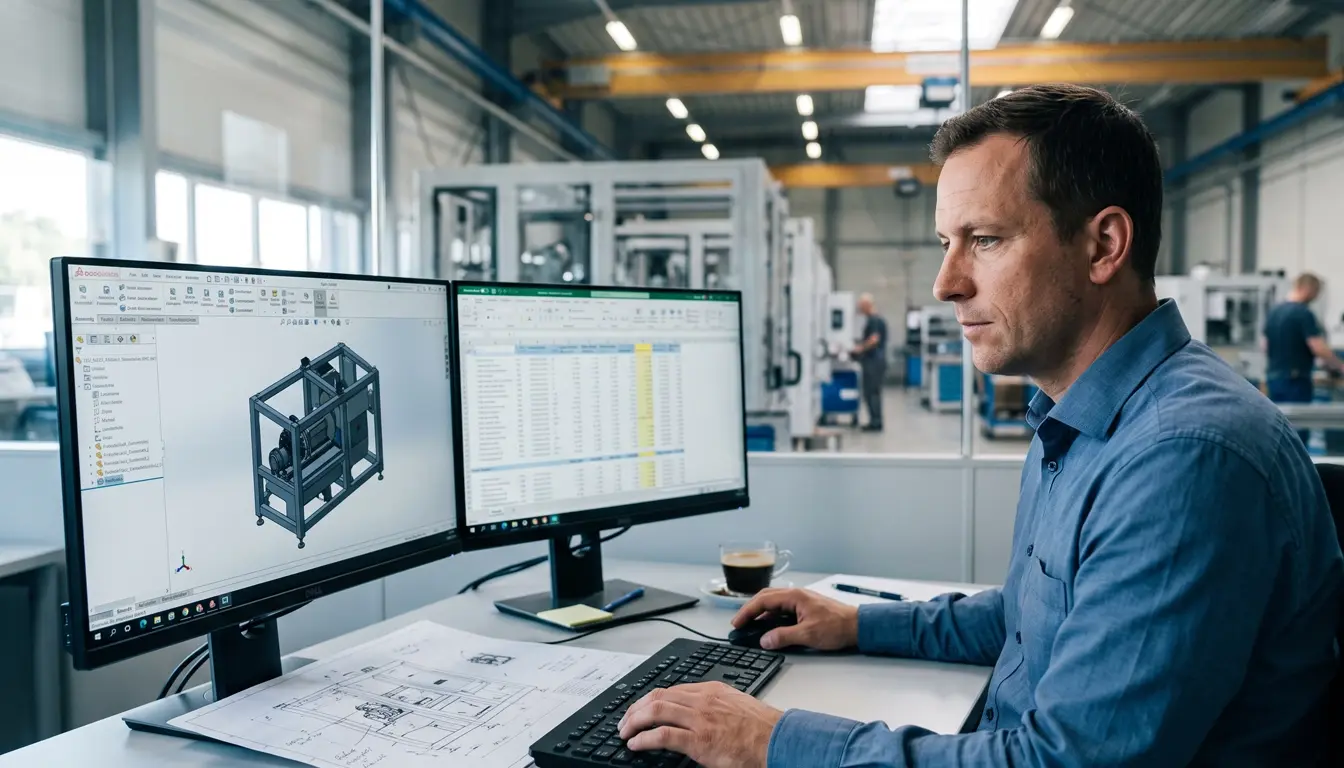

Process analysis of the quotation process at a machinery manufacturer — AI generator rejected, 5–7 hours per quote measured
Challenges
The trigger came from sales: the company was losing time against competitors on tenders, and the management board wanted quotations written by an AI in future.
The data a quotation depends on, however, sat across four categories of system — ERP for parts, bills of material and prices, CAD/PLM for variants and configuration rules, CRM for special pricing and quotation history, and individual Excel sheets for costing. The same product and price data was entered again at five separate points.
Configuration logic lived in engineering rather than in the sales system, so how specific a quotation could be was not something sales could control. The hardest part of the engagement was therefore not the measurement but resetting expectations: the tool had been chosen before the problem was described.
Solution
Dreher Consulting was responsible for mapping the quotation process, mapping its data sources, taking the baseline measurement and preparing the decision paper. Implementation, consolidation of product and price data, and the choice of tools stayed with the company. There was no implementation mandate and no system selection in scope.
Measurement ran across weeks 11 to 16 of 2026, using time recording in internal sales, engineering and field sales, together with defects drawn from rework tickets and feedback from prospective customers. The analysis phase took roughly six to eight weeks.
The analysis reversed the order the project had been conceived in. A quotation wins when it is fast, correct and specific — the text is the smallest part of that. Where product, price and configuration data is inconsistent across ERP, CAD/PLM and costing spreadsheets, a language model produces fluent quotations with the wrong numbers: faster, and in greater volume.
Rejected: an AI text generator on the existing data. It would have scaled the error rather than fixed it.
Retained: consolidating product, price and configuration data into one authoritative source before any conversation about tools.
- 21 process steps documented from enquiry to quotation sent, including the review steps — there had been no end-to-end documented process.
- 5 points identified where the same product, price or configuration data was entered again, caused by separate systems for costing and quotation.
- 4 categories of system holding quotation-relevant data: ERP, CAD/PLM, CRM and individual Excel sheets.
- Three questions to settle before any language model is used: which model, hosted where, and whether the provider trains on the data passed to it.
- Transfers to companies with configurable, high-variant products whose quotation data is spread across ERP, PLM, CRM and spreadsheets. Does not transfer to companies with a standardised catalogue and a single price source — there the text really is the bottleneck.
The measured figures describe the starting position, not an improvement: implementation was outside the mandate. The effect of consolidating the data has not been measured, and no decision has been taken on using a language model in the quotation process. A re-measurement of time per quote, rework rate and win rate is still outstanding.

Machinery and plant manufacturer
Number of Employees 250 Customer Focus B2B, project and series businessA DACH machinery and plant manufacturer wanted an AI to write its quotations. The process analysis measured 5–7 hours and a 15–22% rework rate per quote, and led to the decision to put the data in order first.
Related Customer Stories


Wholesale
Replace a grown in-house system with an integrated standard system — targeting +20% productivity over the legacy system.
View Case Study

Construction Industry & Project Development
Strategic Process Optimisation With Measurable Business Benefits
View Case Study