1. What does "Go" mean in the DAA?
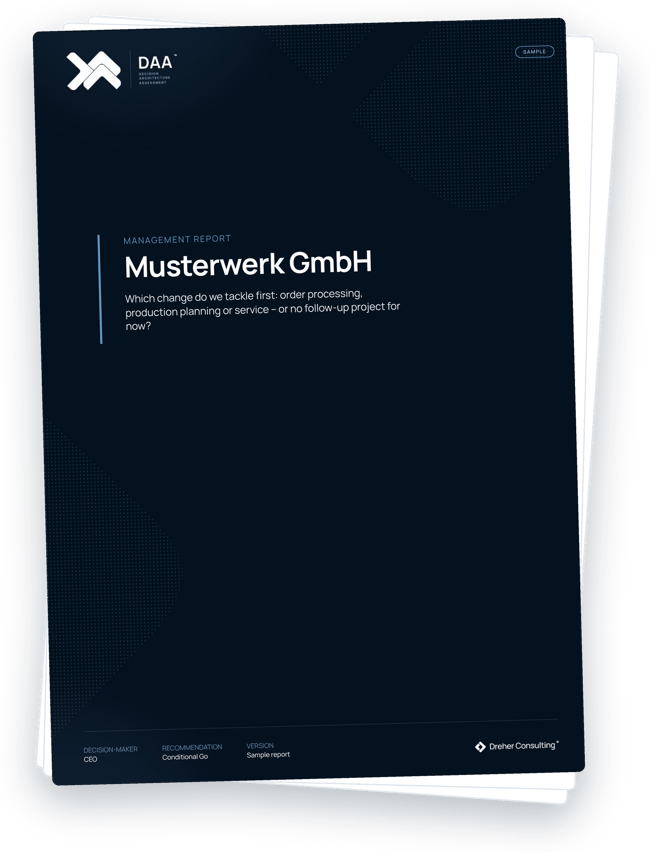
Go means the investment holds up: the target vision, decision logic and the reasons for the investment are confirmed in writing, and the company can move to the next phase. It is not go-live. Conditional Go means yes once named conditions are met. Stop means not in this form.
2. How long does the DAA take?
About two weeks from kick-off to the results discussion: one week of preparation, one assessment day, the Management Report usually 2 working days later, then a 60-minute results discussion.
3. Do you recommend an ERP system in the DAA?
No. The DAA decides whether, why and how an ERP investment goes ahead. Systems are assessed only later, and only if you commission that phase.
4. Can we do this in-house instead?
Internally, the organisation knows the symptoms. The assessment makes the decision audit-ready: who decides, how success is measured and what is deliberately left out. After months without a decision, it is rarely knowledge that is missing – it is a shared decision logic.
5. What if we already know our target vision?
Then the morning session is shorter. The test remains: is the vision defined so that finance, the business unit and, where applicable, shareholders all support the same go/no-go decision – with priorities and stop criteria? If so, we confirm it in writing.
6. Is the DAA a paid engagement?
Yes. It is the first paid step, at a fixed price agreed before the day. The conversations before it are free, and nothing follows automatically: every later phase is a separate decision.
7. How do the DAA, SCOReX and DDI fit together?
With the DAA, we establish the target vision and project structure. With SCOReX, we define what the solution must deliver. With the DDI, we assess which vendor can sufficiently demonstrate this. Only then – under a separate contract – do we govern the implementation on your side, never as the vendor's project manager.
8. How is the DAA different from an ERP pre-study or readiness check?
A pre-study describes the current state. The DAA ends with a decision your management signs – Go, Conditional Go or Stop – including what must be true before any budget is released.
9. What if the result is Stop – have we wasted the money?
No. A Stop before budget is committed is the cheapest result an ERP project can have: you keep a written justification for your advisory board and bank, and no money goes into a system that would not have held up.
10. Who needs to attend?
Senior management in the morning, department heads in the afternoon. One week's notice is enough.
11. Should we keep, upgrade or replace our ERP system?
That is exactly what the DAA answers. Every option is compared with the status quo, at least one option needs no new software, and replacement is recommended only when the other options demonstrably fall short.
12. What does the DAA cost?
It is a fixed price, agreed before the assessment day. The conversations before it are free, and nothing follows automatically.