
Back to Insights
Mastering ERP implementation under MDR compliance: A guide for medtech companies
The Medical Device Regulation (MDR) has fundamentally changed the medical technology industry.
/Herr_Dreher_500x500.jpg)
The Medical Device Regulation (MDR) has fundamentally changed the medical technology industry. MedTech companies are faced with the challenge of meeting stricter requirements for quality assurance, technical documentation and traceability - while at the same time achieving economic efficiency.
According to a survey conducted by MedTech Europe in 2024, 62% of companies report a doubling of approval times, with 37% even reporting an increase of over 200%. The three most common challenges: Adaptation of technical documentation (67%), high certification costs (59%) and complexity of the regulation (58%).
The solution: An ERP system that is specifically geared towards MDR compliance. Such systems centralize data, automate workflows and ensure complete traceability. ERP tools such as SAP Business One or Microsoft Dynamics 365 offer features such as UDI integration and audit trails that are directly aligned with regulatory requirements - with effort reductions of up to 50%.
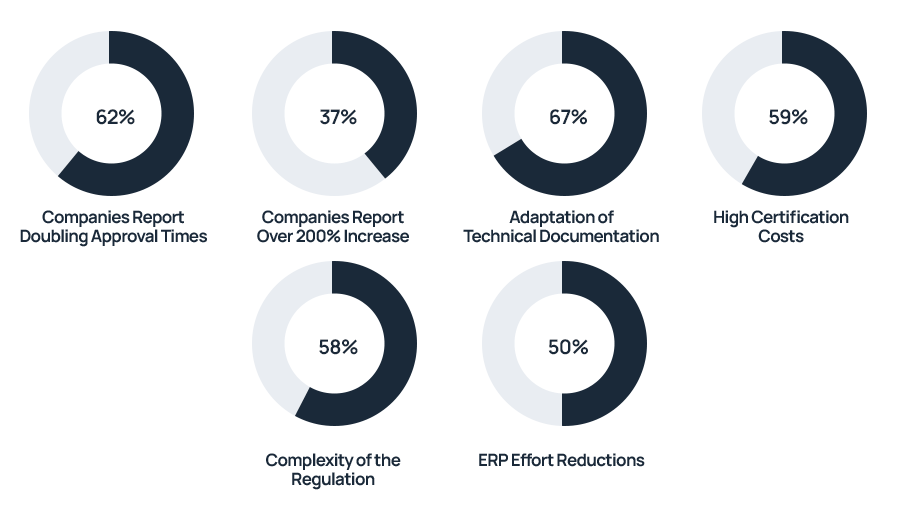
(MedTech Europe 2024 Survey: Approval Times & Challenges)
Understanding the basics of MDR compliance
The EU Regulation (EU) 2017/745, fully applicable since May 2021, replaces the old directives and places higher demands on the safety and performance of medical devices. Key aspects include clinical evaluations, post-market surveillance (PMS) and unique device identification (UDI), which will be mandatory for all new products from 2026.
Why MDR compliance is so challenging
The complexity of the MDR lies in its breadth: it requires comprehensive technical documentation that covers the entire product life cycle and integrates risk management and clinical evidence. According to the Johner Institute, the workload for manufacturers has multiplied. Frequent pitfalls are inconsistencies at notified bodies, which lead to delays.
Recommendation: Start with a gap analysis of your current processes. Tools such as BVMed's MDR checklist help to identify gaps.
Step-by-step guide to ERP implementation
ERP implementation is a strategic process that ensures compliance and increases efficiency. A cross-functional team - from IT to QM to management - is essential.
-
Step 1: Needs analysis and compliance check
-
Start by analyzing your current systems. Which processes (supply chain, documentation) are MDR-critical? Identify pain points such as a lack of traceability or high manual effort.
-
Implementation:
-
Carry out a risk analysis in accordance with ISO 14971
-
Record current costs for documentation (often 30-50% additional effort under MDR)
-
Create process mapping with tools such as Microsoft Visio
Best practice: Integrate stakeholders at an early stage to secure buy-in.
Caution: Do not underestimate the UDI obligation from 2026 - according to a Sycor study, only 40% of companies are prepared.
-
Step 2: Select the right ERP system
-
Not every ERP is MDR-compliant. Choose a validation-capable system with UDI integration, audit trails and automated PMS reports.
-
Selection criteria:
-
Compliance support: ISO 13485, MDR and FDA compliance (e.g. Kumavision on Dynamics 365)
-
Scalability: Cloud-based for flexibility (Odoo, SAP Business One)
-
Integration: Seamless connection to QM tools (CAPA management)
Recommended systems:
-
SAP Business One: Ideal for SMEs, with batch management and traceability
-
Microsoft Dynamics 365: Strong in UDI and AI integration
-
Yaveon: Specialized in MedTech, with GMP-compliant processes
Recommendation : Test demos and get references.
-
Step 3: Plan and implement implementation
-
Plan the introduction in phases: Pilot, rollout, go-live. Budget: 6-12 months, depending on the size of the company.
-
Implementation:
-
Define milestones (e.g. data migration in week 4)
-
Integrate MDR features: Set up workflows for technical documentation
-
Intensive testing: Simulate audits with mock assessments
Best practice: Use agile methods for flexibility.
Caution: Data migration harbors risks - use tools such as Talend for clean transfers.
-
Step 4: Validation and compliance assurance
-
Validation is an MDR obligation. Ensure that your ERP maintains the validated status.
-
Implementation:
-
Perform Computer System Validation (CSV) according to GAMP 5
-
Implement audit trails for change tracking
-
Set up PMS modules for real-time monitoring
Recommendation: Use validation packages from providers such as Kumavision.
-
Step 5: Training, optimization and monitoring
-
After go-live: train and optimize.
-
Implementation:
-
Offer role-based training (e.g. via e-learning platforms)
-
Monitor KPIs (e.g. reduce certification time by 30%)
-
Set up feedback loops for continuous improvement
Best practice: Use BI tools in ERP for dashboards.
Practical example: ERP implementation at a MedTech manufacturer
A medium-sized MedTech manufacturer from Germany (medical instruments, production) was facing massive challenges: The MDR had doubled certification times, technical documentation was fragmented and costs had risen by 50%.
Initial situation: Manual processes in Excel and isolated systems led to errors in traceability. The UDI obligation was not taken into account, audits took months.
Solution: Gap analysis, SAP Business One with MDR add-ons (UDI, audit trails), phased implementation, validation in accordance with ISO 13485, training for 50 employees.
Results:
-
Certification time: reduced from 12 to 6 months
-
Cost savings: 35 %
-
Sales increase: 28% due to faster time to market
-
No recall since implementation
Conclusion
ERP implementation under MDR compliance succeeds through structured requirements analysis, smart system selection, step-by-step implementation, validation and continuous optimization. With our expertise, our tools such as SCOReX and our Atomic Framework, MedTech companies are UDI-ready and audit-proof - with reduced costs and increased competitiveness.


Found this helpful? Let’s explore how these insights could benefit your business.
Click the Contact Us button to connect with me directly.