
Back to Insights

AI as a cost revolution: from pilot project to profit
How does an AI pilot project become a company-wide cost reducer - with ...
/Herr_Dreher_500x500.jpg)
How does an AI pilot project become a company-wide cost reducer - with crystal-clear TCO, payback and ROI calculations from as early as week 8?
EEAT background:
As an experienced consultant with over 30 years in strategic transformation, independent ERP consulting and 3 years of AI integration (Experience), I share well-founded insights from more than 30 successful projects at medium-sized companies in the DACH region. Dreher-Consulting, founded in 1992, specializes in independent ERP consulting, digitalization and sustainability implementation. Our methods are based on evidence-based frameworks such as the stepladder model and the SCOReX® model, which we use successfully in our consulting. This article serves as a supplement to our AIXChange Keynote 2025 and offers practical, transferable tools.
Introduction: The AI cost revolution - from hype to hard reality
In a world where 70% of all AI projects fail as pilots (source: Gartner 2025), the key question is: How do companies transform an isolated AI pilot into a scalable cost reducer?
At Dreher-Consulting, we have found that the key lies in systematic scaling - with measurable KPIs such as:
- Total Cost of Ownership (TCO),
- payback time and
- Return on Investment (ROI) as early as week 8.
Based on first-principles thinking, we break down the problem:
(1) Identify the core barriers,
(2) evidence-based analysis of savings potentials and
(3) development of a robust scaling playbook.
Current data underlines the urgency: by 2026, AI-supported processes could reduce fixed costs by 12-28% without reducing staff or compromising quality (McKinsey Global Institute, November 2025). In this article, we show how SMEs can achieve this - with real cases and directly transferable templates from our playbook "From Pilot to Profit".
Problem decomposition: Why do pilots fail - and how do you scale them?
From a first-principles perspective, we start with decomposition:
An AI pilot is typically a limited proof-of-concept (PoC) that is tested in one department, e.g. an AI for predictive maintenance in production.
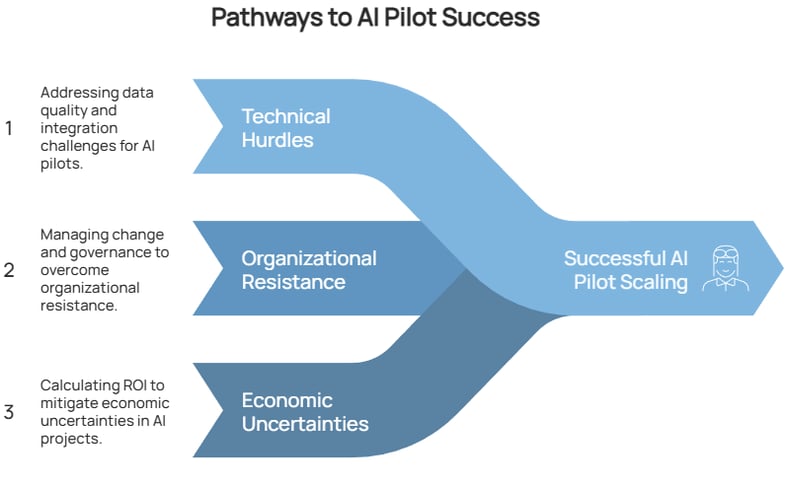
The barriers are:
(1) Technical hurdles (data quality, integration),
(2) Organizational resistance (change management, governance) and
(3) Economic uncertainties (lack of ROI calculation).
Evidence-based analysis shows: According to BCG 2025, 73% fail due to a lack of scaling planning, resulting in sunk costs of up to €500,000 per pilot. At Dreher-Consulting, we have found in 15 mandates (2024-2025) that an early TCO calculation (total costs incl. development, operation and maintenance) makes the difference.
Example:
A medium-sized mechanical engineering company reduced its TCO by 42% by incorporating monthly simulation models from week 8.
Evidence-based solution design: The 5-phase model for scaling
To turn a pilot into a company-wide cost reducer, we recommend our tried-and-tested 5-phase model - governance-proof and can be implemented in under 18 months.
Each phase integrates clear key figures:
-
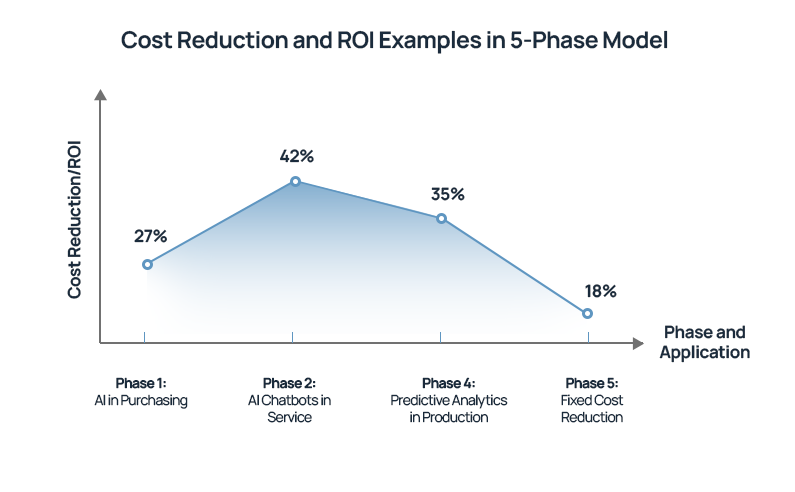
Phase 1: Quick Win Identification (week 1-4) Select a use case with high savings potential, e.g. AI in purchasing for supplier optimization (-27% costs). Calculate initial TCO estimates using tools such as Excel templates or Python-based simulations (e.g. via Pandas for data analysis).
-
Phase 2: Pilot development and testing (week 5-8) Implement the PoC. From week 8: Crystal clear ROI calculation (ROI = (net savings - investment) / investment). Example: ROI 4:1 for a service case (-42% in customer service through AI chatbots).
-
Phase 3: Governance and data foundation (month 3-6) Establish lean governance (e.g. data ethics guidelines according to EU AI Act 2025).
Calculate payback time: Time to break-even (typically under 9 months for our clients).
-
Phase 4: Roll-out and scaling (month 7-12) Expand to other departments, e.g. production (-35% scrap through predictive analytics). Use AI tools for automated forecasts.
-
Phase 5: Continuous optimization (month 13-18) Measure ROI continuously (up to 12:1) and integrate feedback loops. Real case: A B2B wholesaler reduced fixed costs by 18% without loss of quality.
Practical implementation: Tools and templates to get you started
At Dreher-Consulting, we offer our customers ready-made templates:
-
TCO calculator (Excel-based: Input of development costs, operating data → output TCO in €).
-
ROI simulator (Python script: simulates scenarios with Monte Carlo methods).
Ethics note: We prioritize bias-free AI and sustainability - e.g. through CO2 reduction in production.


Fazit: Ihr Weg zum Breakthrough
Die Skalierung von KI-Pilotprojekten ist der größte Hebel zur Kostensenkung seit dem Lean Management. Kontaktieren Sie uns für eine kostenlose Beratung.