

Back to Insights

Where are the levers for sustainably reducing costs through AI?
The question of the specific cost levers of artificial intelligence is ...
/Herr_Dreher_500x500.jpg)
The question of the specific cost levers of artificial intelligence is currently occupying almost every management board in German-speaking SMEs.
With 4-6 billion daily AI queries worldwide (as of November 2025), the technology has long since outgrown the experimental phase. Nevertheless, analyses show that around 70 percent of all AI projects do not deliver the expected results. The main reason: companies do not identify the right levers for their specific context.
Based on Dreher Consulting's consulting practice, this guide shows you where the real potential lies - and how you can tap into it methodically.
The cost reduction potential: 12-28 % fixed costs by 2026
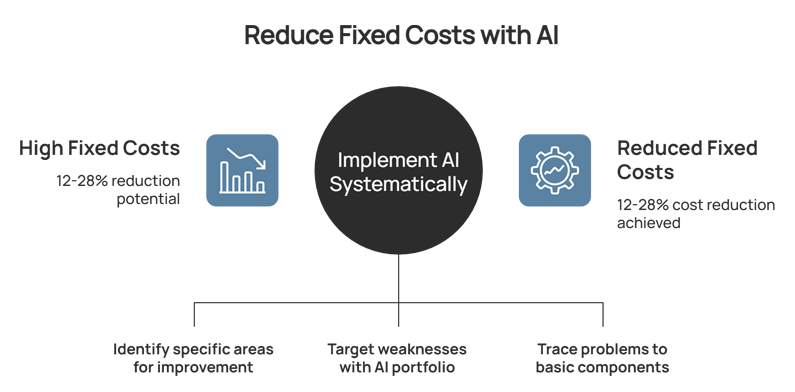
Current market analyses and our project experience show: Medium-sized companies can reduce their fixed costs by 12 to 28 percent through the systematic use of AI. This range results from differences in industry, degree of digitalization maturity and chosen implementation approach.
It is crucial to understand that AI is not a monolithic solution, but a portfolio of technologies that need to be applied to specific process weaknesses. The first-principle approach - i.e. tracing complex problems back to their basic components - forms the methodological basis for identifying levers.
The three primary areas of leverage in operational business
Our process analyses in over 120 SME projects consistently show three areas with the highest ROI potential for AI-supported optimization:
1. Purchasing and procurement
Purchasing regularly offers the fastest quick wins with high scaling potential. The levers are distributed across the following functional areas:
- Determining requirements and scheduling
Traditional MRP systems (material requirements planning) often generate a flood of exception messages that have to be processed manually. AI-based demand sensing algorithms reduce this exception rate by 40-60 percent by automatically incorporating seasonal and promotional corrections and intelligently prioritizing MRP runs that can be scheduled. - Order processing and approval workflows
The degree of automation for purchase orders (PO) and EDI processing is less than 50 percent in many companies. AI-supported touchless order processes, automatic BST generation and intelligent call-off orders can increase this figure to over 85% - with corresponding savings in personal capacity. - Supplier management
AI-based supplier evaluation and automatic qualification scores enable more objective and faster supplier selection. Particularly in regulated industries such as medical technology, the automatic check in the sanctions monitor significantly accelerates compliance processes.
2. Warehouse and inventory management
Intralogistics offers considerable efficiency potential through AI optimization, which has a direct impact on working capital and personnel costs:
-
Dock-to-stock optimisation
The time from goods receipt to storage (dock-to-stock cycle time) is 12 hours or more in many companies. AI-supported ASN (Advanced Shipping Notice) processing, automatic put-away logic and rule-based random checks can reduce this value to 4 hours - DACH benchmark companies even achieve 2 hours. -
Picking and picking strategies
Multi-order picking, mobile pick lists and pick-and-pack checks using vision AI reduce error rates and increase throughput per employee hour. The integration of stock issues during shipping in real time also minimizes stock discrepancies. -
Inventory and stock correction
Cyclical inventory planning with AI-based tolerance limits and mobile counting significantly reduces the effort required for full counts. RFID or camera-based inventory solutions (Vision AI) can reconcile variances within 24 hours.
3. Store operations and point of sale
There are additional levers for companies with chain stores or stationary retail:
-
Checkout processes: automatic barcode/PLU capture, price and VAT checks and mixed payment capability reduce transaction times and error rates.
-
Price and discount management: AI-driven price synchronization, automatic promotion periods and dynamic mix-and-match discounts increase margins while increasing customer loyalty.
-
Returns management: Intelligent returns at the POS with automatic stock booking and fraud detection through pattern analysis.
Methodology: How do you identify your specific levers?
The systematic identification of the right levers follows a structured procedure that we at Dreher Consulting call the 'Atomic Intelligence' approach:
Step 1: Create a process map
The first step is to create a complete overview of all operational processes - from determining requirements to warehousing and the point of sale. This map forms the basis for further analysis.
Step 2: AI readiness assessment
Each process is evaluated in terms of its suitability for automation. Criteria include data quality, process standardization, integration effort and expected business impact. The result is a colour-coded matrix (red = need for action, yellow = optimization potential, green = already optimized).
Step 3: KPI-based prioritization
Specific target values are defined for each identified lever. Example: Reduction of the dock-to-stock cycle time from 12 to 4 hours (achievable) or 2 hours (DACH best practice). These KPIs enable objective prioritization according to ROI potential.
Step 4: Develop a roadmap
Implementation takes place within defined time horizons: Quick wins within 6 months, medium-term levers in 1-2 years and strategic transformations in a 5-year horizon. This staggered approach ensures an early sense of achievement while simultaneously building sustainable competitive advantages.
"70% of AI projects fail. The other 30% have correctly identified their levers."
Success factors for implementation
The successful realization of the identified potential depends on several factors:
-
Data quality: AI models are only as good as their training data. Cleansing and standardizing master data is often a prerequisite.
-
Change management: Employee acceptance is the key to success or failure. Early involvement and training are essential.
-
ERP integration: Isolated solutions create new silos. Integration into existing ERP systems (SAP, Microsoft Dynamics, proALPHA, etc.) is crucial for scalability.
-
Governance and compliance: Particularly in regulated industries (medical technology, food), AI solutions must meet standards such as ISO 27001, ISO 9001 or industry-specific requirements.
Conclusion: the right time is now
The question "Where are the levers?" cannot be answered in general terms. It requires a systematic analysis of your own process landscape, an honest assessment of the status quo and a clear prioritization according to business impact.
The companies that carry out this analysis now will be among the 30 percent whose AI projects deliver the expected results in 2026.
The head start will not come from waiting for the 'perfect' solution, but from taking structured action with the resources available today. The innovation curve is exponential - those who start today will increase their lead over competitors who are still hesitating.


Found this helpful? Let’s explore how these insights could benefit your business.
Click the Contact Us button to connect with me directly.