How SCOReX® Improves ERP Selection Through Better Decision Logic
Short answer: An integrated, AI-supported approach such as SCOReX® This shifts the focus from manual documentation to structured knowledge orchestration..
Short answer: An integrated, AI-supported approach such as SCOReX® This shifts the focus from manual documentation to structured knowledge orchestration.
The result: Up to 30% faster requirements gathering, significantly higher consistency and more robust decisions– while simultaneously reducing project costs.
Why many ERP projects are still unnecessarily expensive and risky
In practice, many ERP selection projects still follow the same pattern:
weeks of workshops to capture the current state
parallel documentation in Excel, Word and presentations
inconsistent requirements across departments
late corrections in the selection process
The structural problem is that many ERP projects are still document-driven rather than decision-driven.
The result is predictable:
high time expenditure
limited transparency
inconsistent prioritisation
suboptimal system decisions
The shift: from documents to decision logic
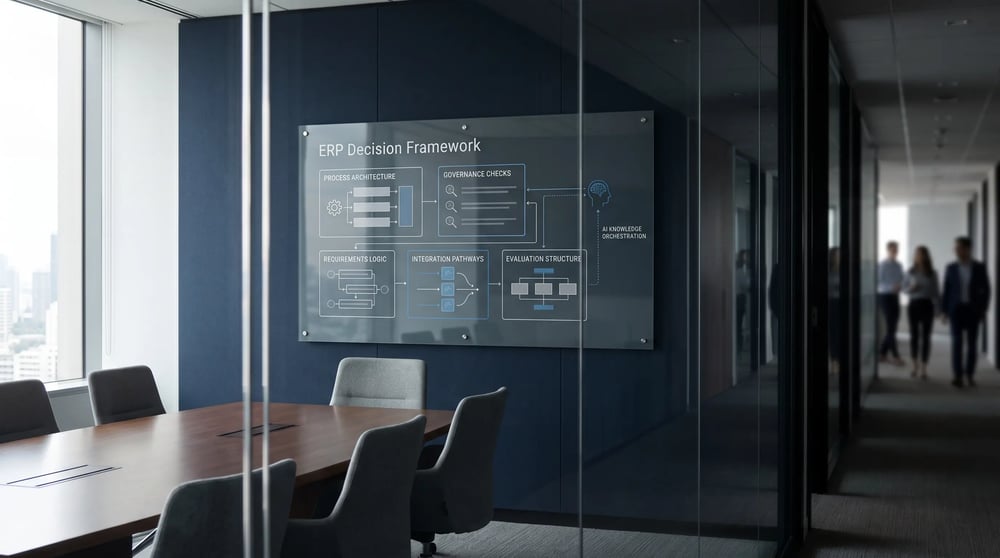
SCOReX® changes the underlying logic of ERP selection.
Traditional approach
SCOReX® approach
Create documents
Word docs, spreadsheets, RFPs
Define the target state
Goals and requirements first
↓
↓
Consolidate content
Merge, review, align teams
Capture knowledge structurally
Structured, comparable data
↓
↓
Derive decisions afterwards
Late-stage, post-hoc reasoning
Derive decisions systematically
Logic-driven, built in from the start
Decisions as an afterthought
Decisions as a built-in outcome
The core principle is simple: The specification is not the real goal. The real goal is a robust, consistent basis for decision-making.
The SCOReX® process model in four steps
1. Pre-structuring instead of starting from scratch
SCOReX® begins with target processes, reference models and clearly defined action areas. This creates an initial requirements structure before workshops begin.
Result: the team focuses on relevant issues instead of starting with empty workshop rooms.
↓
2. Workshop orchestration instead of minute-taking
Workshops are used to validate and refine what matters, not simply to collect information. Content is captured in a structured form and consolidated directly, while preserving context.
Result: less rework, higher quality and fewer inconsistencies.
↓
3. Dynamic requirements specification generation
Requirements are developed consistently from the system itself, with links between processes, requirements and architecture. Instead of creating a static document that ages quickly, the requirements structure remains dynamic and usable.
Result: a requirements specification that supports the project instead of slowing it down.
↓
4. Scenario-based supplier evaluation
Suppliers are evaluated against real business processes, not just feature checklists. Fit-gap analyses are derived from a structured knowledge base, making decision logic more transparent.
Result: decisions are based on operational reality, not generic scoring templates.
Concrete benefits for mid-sized companies
Across projects, the core benefits of this approach are clear.
Efficiency
25–30% faster requirements gathering
Fewer iteration loops
Quality
Greater consistency of requirements
Better comparability of suppliers
Risk
Earlier visibility of critical issues
Fewer surprises during implementation
Cost
Reduced project effort
Fewer wrong decisions & less cost
What really changes for project teams
The biggest change is not technological. It is methodological.
Previously
Document
Collect and write down everything
Structure
Organise content into categories
Consolidate
Merge and align across teams
With SCOReX®
Interpret
Read patterns in structured data
Validate
Test against defined requirements
Steer
Drive decisions systematically
New Core Capability
Derive the right decisions from structured knowledge.
A practical example
One manufacturing company with multiple sites faced an ERP re-selection challenge.
The starting position was difficult:
different process variants across locations
high coordination effort
unclear target architecture
Using SCOReX®, the project team was able to:
pre-qualify processes in a structured way
harmonise key workflows
derive requirements more consistently
Result: shorter project duration, a clearer management-level decision basis and greater certainty in system selection.
Conclusion: quality beats speed, but SCOReX® supports both
The future of ERP selection does not lie in producing faster documents. It lies in creating better decision structures.
An integrated process model such as SCOReX® supports:
greater speed
higher quality
lower risk
The decisive point is that technology is not used in isolation. It becomes part of a clearly structured method for preparing better decisions.
Final thought
Many ERP projects fail not because of the technology, but because of the way the decision is prepared.
So the real question is not: Which ERP system is right for us? The better question is: How sound is our basis for decision-making?
If you want to answer that question for your company in a more structured way, it is worth taking a closer look at process models that go beyond traditional specification logic.
SCOReX® is Dreher Consulting’s structured, AI-supported methodology for ERP selection. It helps companies improve ERP requirements gathering, supplier evaluation and decision-making by moving the process away from document-heavy specification work and toward a stronger, more consistent decision basis.
SCOReX® improves ERP requirements gathering by pre-structuring target processes, reference models and action areas before workshops begin. This helps companies reduce workshop overload, speed up requirements gathering, improve consistency across departments and create a more usable requirements structure for ERP selection.
Many ERP selection projects become expensive and risky because they are still document-driven instead of decision-driven. Common problems include long workshop cycles, fragmented documentation in Excel and Word, inconsistent requirements, weak supplier comparability and late corrections during ERP selection and implementation planning.
SCOReX® improves ERP supplier evaluation by testing suppliers against real business processes instead of relying on generic feature checklists. This makes fit-gap analysis more transparent, improves software comparability and supports more robust ERP decisions before vendor commitment hardens.
SCOReX® reduces ERP project risk by identifying critical issues earlier, improving process and requirements consistency and surfacing gaps before they become implementation problems. This can reduce rework, avoid wrong decisions and create a stronger decision basis for ERP selection and transformation planning.
Yes. SCOReX® is designed to make ERP selection more efficient by reducing unnecessary iteration loops, structuring knowledge earlier and improving workshop effectiveness. The result is faster requirements gathering, clearer decision logic and less wasted effort during ERP selection projects.
Traditional ERP selection often focuses on producing documents, consolidating workshop outputs and deriving decisions late in the process. SCOReX® starts with the target state, captures knowledge in a structured way and derives decisions systematically, which creates a more reliable and defensible ERP selection process.
Decision logic is important in ERP selection because the quality of the final ERP decision depends on how well requirements, processes, governance and supplier fit are structured and tested. A stronger decision basis helps companies avoid weak assumptions, poor comparability and costly mistakes during implementation.
SCOReX® supports better ERP decision-making by helping project teams move from documenting and consolidating information to interpreting, validating and steering decisions more systematically. This improves transparency, reduces ambiguity and helps management make more defensible ERP decisions.
See how better decision structure helps.Speak to us to arrange a conversation.

/Herr_Dreher_500x500.jpg)


 Download Article as PDF