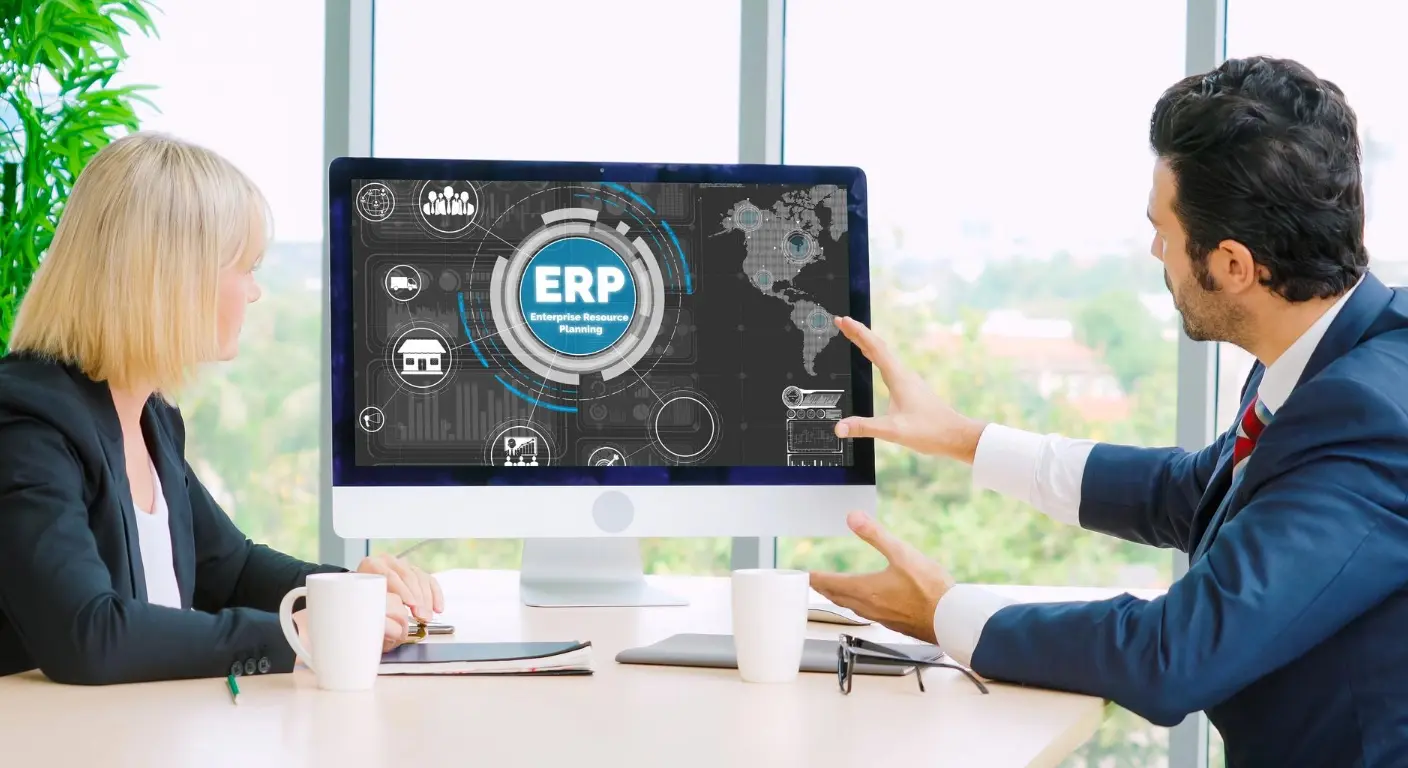
The ERP industry has been marching aggressively towards cloud deployments for around a decade.
Almost all major software providers are pursuing a clear "cloud-first" strategy. Providers such as NetSuite, Salesforce and Workday have impressively demonstrated scalability and, above all, profitability through recurring subscription revenue. According to recent analyses by Gartner, the share of cloud-based ERP deployments will rise to over 65 percent by 2028.
However, despite this momentum, many companies - especially in the SME sector - are overlooking significant blind spots in this development. At Dreher Consulting, we want to shed light on these critical risks. Because if we continue on our current course without reflection, we face the threat of a tangible cloud ERP crisis in the 2030s, which will massively restrict companies' ability to act.
| |
Core thesis: The cloud-first strategy of ERP providers primarily serves their business model - not necessarily the long-term interests of user companies. Those who do not take countermeasures today will lose control of their business-critical processes tomorrow.
|
1. the illusion of limitless flexibility: why you lose control
One of the main reasons for the impending crisis is the creeping loss of control. Companies are handing over control of their essential business processes to cloud providers and their technologists, who alone decide how the software will work in the future, which modules will be developed further - and which will not.
Cloud providers are currently enticing customers with standardized "best practices" and processes that promise rapid scaling. But if you look at a time horizon of five to fifteen years, a different picture emerges: Your company will continue to evolve, enter new markets, adapt business models. From our experience in over 500 ERP projects, we know that standard technology will not necessarily grow in step with the individual needs of your organization.

Practical example: When the provider decides against your interests
Software providers make strategic decisions that benefit the majority of their customer base - but not every single company. It can happen that essential modules, on which a large part of your turnover is based, are discontinued by the provider, fundamentally changed or transferred to an additional package for a fee. In the cloud world, you are far more at the mercy of these long-term provider decisions than was the case with traditional on-premise solutions.
This loss of control contradicts a basic principle of sound corporate management: sovereignty over business-critical infrastructure. Frameworks such as ITIL and COBIT explicitly emphasize the need to anchor control over IT services within your own organization - not with third parties.
2 The cost trap: why cloud ERP is more expensive in the long term
A widespread myth that we regularly challenge in strategic consulting is the assumption that cloud systems are cheaper in terms of total cost of ownership (TCO) than running your own on-premise software. This statement does not stand up to critical scrutiny in almost any customer environment.

TCO comparison: Cloud vs. on-premise over 10 years
| Cost factor |
Cloud ERP |
On-premise ERP |
| License/subscription costs (10 years) |
Continuously increasing (ø 5-8% p.a.) |
One-off license + maintenance (ø 18-22 % p.a.) |
| Infrastructure costs |
Included in the subscription, but not controllable |
Own control, amortization possible |
| Customization costs |
Limited, often additional costs |
Flexible, internally controllable |
| Exit costs |
Very high (data migration, reconfiguration) |
Moderate |
| Room for negotiation |
Low after contract conclusion |
Higher due to ownership rights |
The net costs you pay to the software provider are generally higher than ever before with on-premise solutions. The model is like leasing a car: the installments never end. Worse still - in the long term, operating expenses increase massively due to escalating contract terms and new pricing models from providers. Industry analysts have observed average annual price increases of between 5 and 8 percent among the leading cloud ERP providers.
| |
|
Dreher Consulting recommendation: Before making any cloud ERP decision, create an independent TCO analysis covering at least 7-10 years. Consider not only the direct subscription costs, but also indirect factors such as training, data portability and potential exit costs. Use a first-principle approach to separate the actual cost drivers from vendor promises.
|
|
3. the loss of the "secret sauce": Why standardization threatens your competitive advantage
Perhaps the most critical aspect of cloud ERP migration concerns an organization's intellectual property and differentiating business processes. In traditional on-premise models, organizations had maximum flexibility to customize software to their exact needs through custom code. Today, this practice is often dismissed dismissively as "old school".
Yet many executives overlook a crucial point: it is often in these customizations that the so-called "secret sauce" - the unique workflows and intellectual property that gives you a real competitive advantage - is found. It is the reason why customers choose you over the competition.
Standardization means average - not best practice
Standardized cloud software "off the shelf" does not offer real best practices that fit perfectly for every individual company. What providers market as "best practice" are in reality average processes - the lowest common denominator across thousands of customers. Michael Porter formulated this clearly in his competitive strategy: Sustainable competitive advantage comes from differentiation, not conformity.

If you give up this individualization when migrating to the cloud, you sacrifice part of your entrepreneurial DNA. What's more, future upgrades will be enforced by the providers - regardless of whether the timing or the new functions make sense for your business. And if you then have to switch systems at some point, you are faced with a massively complex and costly migration process.
| |
|
"If all competitors use the same standardized processes, there is no longer any process advantage. Differentiation only arises where companies consciously deviate from the norm." - Strategic principle of the Dreher Consulting consulting philosophy
|
|
4. strategic recommendations for action: How to secure your ERP future
We do not recommend completely ignoring the inevitable trend towards the cloud - the majority of future-proof solutions will be cloud-based. However, the decisive factor is how you organize the transition. At Dreher Consulting, we recommend the following strategic measures to maintain control of your business-critical systems.
Recommendation 1: Avoid the single-vendor lock-in
Don't put your entire business operations on a single card. Deliberate diversification through the use of several ERP systems or complementary best-of-breed solutions is a sensible safeguard. While this leads to greater integration complexity from a purely technological perspective, this risk is justifiable in order to minimize the far greater business risk of total dependency.
Concrete approach: Define your core processes according to the first-principle approach. Identify which processes can be standardized and which are your differentiators - and choose the technology accordingly.
|
|
Recommendation 2: Rely on cloud platforms instead of rigid applications
Consider using cloud platforms that not only provide you with a single, ready-made application, but also offer you the option of developing your own customized applications within the platform. This allows you to combine the benefits of standardized cloud solutions with the flexibility you need for your unique core processes.
Concrete approach: Evaluate platforms according to the "extensibility" criterion in accordance with ISO 25010 (software quality model). Look for open APIs, low-code/no-code development options and the ability to provide your own code in a protected environment.
|
Recommendation 3: Establish ERP as a strategic management issue
The choice and design of the ERP strategy is not just an IT decision. It is a fundamental management and strategic question that must be taken at the highest management level - taking into account long-term risks, costs and strategic corporate values.
Concrete approach: Establish an ERP steering committee at C-level (CEO, CFO, CIO). Define ERP governance guidelines analogous to proven frameworks such as COBIT or ITIL. Have the ERP strategy regularly validated by independent consultants.
|
Recommendation 4: Contractually secure your data sovereignty
Before signing a cloud ERP contract, negotiate clear regulations on data portability, exit scenarios and data sovereignty. Ensure that your data can be exported at any time in a standardized format and that contractual SLA guarantees safeguard the availability and integrity of your business-critical data.
Concrete approach: Follow the requirements of ISO 27001 (information security) and the GDPR. Define exit clauses that stipulate maximum transition periods and the provider's data provision obligations.
|
Conclusion: Cloud yes - but with a strategic sense of proportion
The cloud transformation of the ERP landscape is not a passing trend, but a structural shift. However, this is precisely why it deserves strategically sound support that goes beyond the providers' marketing promises. Companies that do not take active countermeasures today risk a significant reduction in their ability to act in the 2030s - through dependencies, rising costs and the loss of differentiating business processes.
At Dreher Consulting, we support SMEs in successfully navigating the fine line between cloud innovation and strategic control. Our approach is based on independent, vendor-neutral consulting that does not follow the interests of the software providers, but only your business objectives.
About the author
Harald Dreher is the founder and managing director of Dreher Consulting. For over 25 years, he has been supporting medium-sized companies in the DACH region in the strategic selection, introduction and optimization of ERP systems. His consulting approach combines business depth with technological understanding - always vendor-neutral and exclusively in the interests of his clients.
More about Dreher Consulting →



/Herr_Dreher_500x500.jpg)

 Download Article as PDF