IT Strategy Consulting for Secure, Future-Ready IT Systems

Strategic, independent IT advisory that aligns your IT landscape with business goals. Strengthen your infrastructure with AI-enhanced assessments, long-term IT roadmaps and expert guidance that drives measurable digital transformation.

Get Expert Advice


When cost reductions of the classic kind no longer allow much potential...

It becomes crucial to gain clarity on process optimisation and the role of IT as a supporter of business processes.

An important instrument for this is the development of an IT strategy, which, derived from the classic corporate strategy, defines the roadmap for IT, which services and which programmes are to be delivered when.

Because every company and every organisation usually has special, individual structures and processes, it does not make sense to roll out the "one" strategy to a company. In the recent past, the product portfolio of the large IT system houses with their mostly large ERP systems has changed considerably. Whereas a few years ago it would have been unthinkable to store your data in the cloud, today cloud applications have easily overtaken on-site installations.

Digital Maturity Test
  Assess your Digital Readiness
background-careers-consulting Background transition
banner overlay image


We deliver the finest results with 30 years of independent experience

Gain a quick insight into how our team works and the value our IT strategy consulting brings to your organisation.


IT Strategy - What does it mean and why is it so important?

A modern IT strategy sets the foundation for secure, flexible and future-ready IT within your organisation.

As expectations around mobile usability, data analysis and automated processes continue to grow, companies need a clear framework to guide technology decisions.

A well-defined IT strategy highlights which applications you need, how they support your business processes and where each system currently stands in its life cycle. It also identifies when upgrades, replacements or new solutions are required, helping you understand your digitalisation status and upcoming challenges.

At Dreher Consulting, our focus is on practical implementation, not abstract marketing concepts. With decades of independent experience, we support you in analysing your IT landscape, designing a resilient strategy and rolling it out successfully — ensuring your organisation remains competitive in an increasingly digital world.


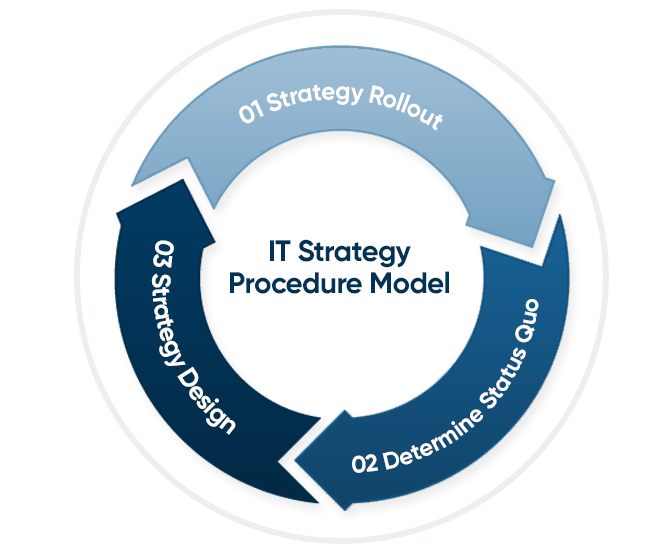
it-strategy-procedure--model


Above all, an important point is to define the goal of the IT strategy: why is an IT strategy being developed and what information should it provide? In this context, it is also important to distinguish it from the out-of-scope - what is not the content of the IT strategy. 

Developing and implementing an IT strategy - what services do you receive?

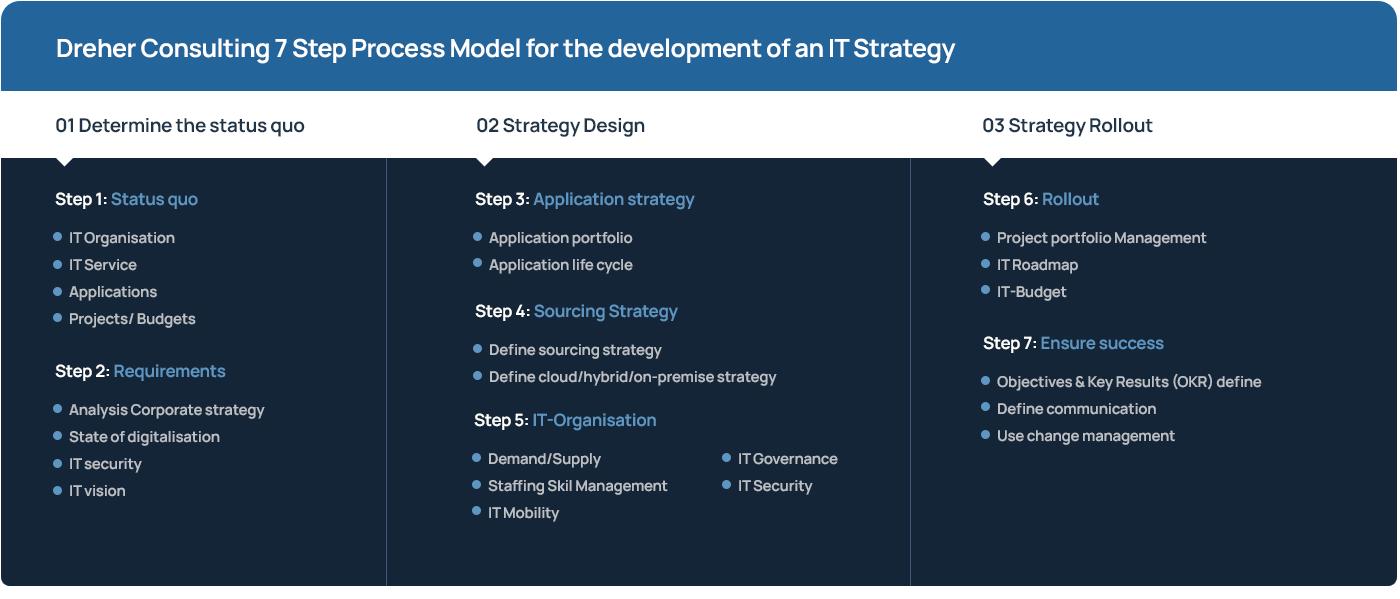
The process model we use for IT strategy development has been tested in practice and delivers the desired results in a short time. We start with the preparation of the IT strategy, which we call the ramp-up phase. In this phase, the team is defined, the timeline is set and various necessary project management tasks are carried out. 

7step-plan
Snowsports_AlproofTour_Sideshot-24_Julian_Bueckers Background transition
banner overlay image

quote-digi

For 15 years we have been working with Dreher Consulting on various tasks in the context of process optimisation. We have achieved all our goals and will work with Dreher Consulting again."

Bernd Kullmann Managing Director | Deuter
View Case Studies


Where do you and your company stand today in relation to an IT strategy?

Step 1: Determining the status quo.

We work with the team to determine the maturity level of IT use to date. The IT organisation, the IT service, the IT applications (mostly ERP software), as well as the characteristics of the previous and future IT projects are examined and presented as a result. Strengths and weaknesses become clear very quickly and give indications of possible focal points.

Used as the basis and derivation of challenges for the IT strategy. The classic instruments such as Porter's 5-Forces Competitive Analysis as well as portfolio management tools are used. In the process, the business processes and the requirements of the customers for the services as well as the expected value-added processes for the customer are examined in the specialised departments. From this, a first rough vision of an IT strategy is developed.

Designing the IT strategy

Step 3: Design application strategy

Based on the information and data collected and available, the life cycle of individual applications is presented and completed with the help of portfolio management. Based on this assessment of the maturity level of an application, an evaluation is made for all programmes in use. This usually includes the assessment of core programmes such as ERP software, associated extensions, independent third-party programmes and infrastructure programmes.

From this, courses of action develop such as: Continue Use, Replace, Modernise (Upgrade). These options for action are given the parameters of time and priority and ordered in a programme roadmap. The result is a representation of what a future application portfolio and programme landscape oriented to the new challenges should look like, based on a status quo analysis.

In this step, the IT strategy is elaborated in the context of sourcing or a possible cooperation with external partners. Fundamental questions about the use of cloud solutions, make-or-buy scenarios, hybrid solutions for mixed operation in the own data centre or with external service providers, as well as necessary service level agreements are part of the outcome of the sourcing strategy.

Requirements for the IT organisation and IT governance within the framework of an IT strategy. Based on the future requirements to support the business processes, it is shown how the IT strategy can be implemented on the basis of the demand/supply model. It is taken into account that all business goals are reflected in the requirements of the IT strategy. Within the framework of IT governance, it is examined whether the relevant requirements of the GDPR, data security and IT security are taken into account in the development of the IT strategy.

The role of the head of IT (CIO) is also defined in the process. In companies with several locations, the question is also clarified as to which services are performed centrally and which IT services are performed decentrally. This is also examined with regard to the support of business applications (e.g. ERP software). Based on a gap analysis, the derived personnel strategy will show whether the employees with the right skills can make the future IT strategy effective.

Implementation Roll-Out

Step 6: Implementation of the developed IT strategy

The creation of a roadmap starts on the basis of the previous steps 1 to 5 and shows which measures and projects need to be in the pipeline for the next 3-5 years. Based on this roadmap, a rough cost estimate is made. It is checked whether all measures are realistic and financially feasible. With the help of portfolio management, an assessment and prioritisation of upcoming projects is carried out. This ensures that only those projects are realised that offer the company a competitive advantage.

For this purpose, the OKR methodology is used to define the KPIs. Communication to staff and project participants is aligned and linked to the roadmap, both technically and in terms of time. Measures for supporting and accompanying the employees in change management are worked out and are thus available to the management for the decision on the adoption of the IT strategy.


What you get from us

  • A site assessment through IT - a product life cycle for the individual software packages and solutions.

  • Information on the assessment of when which system should or must be replaced for technical or functional reasons.

  • Information about the implementation of your corporate strategy in the IT strategy to map customer requirements of the future.

  • Tips for the automation of standardisable processes, cost savings or efficiency increases of business cases focussed on digitalisation requirements.

  • Best practice tips for optimisation of IT structures, IT cost reductions and IT service management.

  • Confirm effort is reasonable and what service level your IT strategy defines for the support of your employees and customers.

  • A detailed report with instructions for action and an implementable action plan for an IT strategy that meets the digital challenges.

retail-cta dots background image

Ready to Strengthen Your
Digital Strategy?

Talk to an expert today and get clear guidance for your next steps.

Get Expert Advice

Get in Touch