
Back to Insights
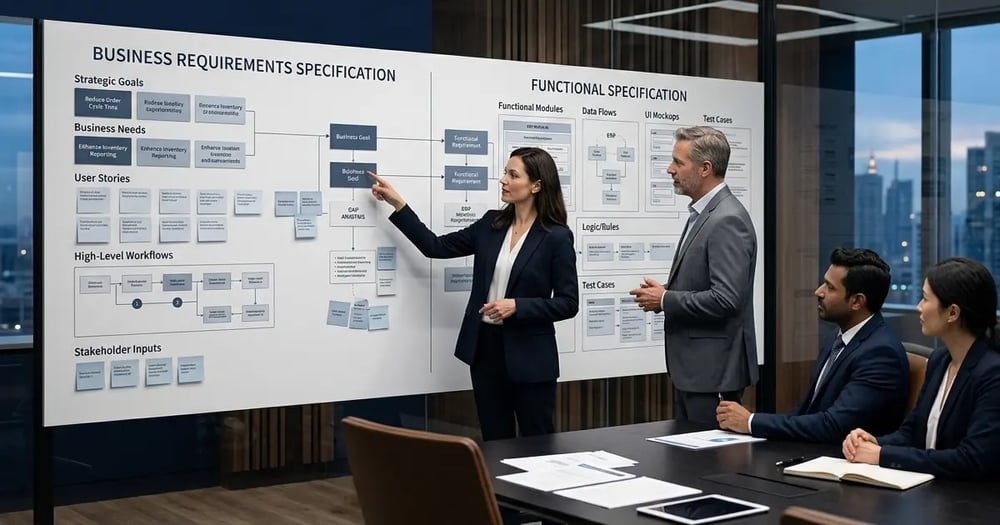
Requirements Specification Vs Functional Specification
The terms Requirements Specification and Functional Specification are often used interchangeably in everyday work and in ERP projects.
/Herr_Dreher_500x500.jpg)
The terms Requirements Specification and Functional Specification are often used interchangeably in everyday work and in ERP projects.
Both documents fundamentally represent requirements, or descriptions of one or more states, products, or an expected service. Yet the Requirements Specification and the Functional Specification play distinct, important roles in contract management. This article explains the meanings and differences in a "Requirements Specification versus Functional Specification" comparison, presented clearly.
Quick summary — Requirements Specification vs. Functional Specification in 40 secondsThe Requirements Specification describes, from the client's perspective, what an ERP solution must deliver; the Functional Specification describes, from the vendor's perspective, how it will be delivered. The Requirements Specification defines business processes, requirements, and goals. The Functional Specification is developed jointly with the software vendor and forms part of the contract under § 631 of the German Civil Code.
|
Requirements Specification – When is a Requirements Specification needed?
In its broadest sense, a Requirements Specification is a specification of the services required (target concept or requirements catalog). It defines, sometimes in considerable detail, the requirements of management with respect to reporting, of the affected employees and process owners with respect to transactions and the support of processes through an ERP system, as well as the technical framework conditions.
A Requirements Specification should describe the requirements for a solution or for a software system intended to support the running of the company (for example, ERP software).
Within the framework of management's requirements, the corporate strategy, and the IT strategy derived from it, the broad direction and goals for the coming years are established. To define the requirements for new software (for example, a new ERP solution), it is essential to derive and document those requirements from the corporate strategy. Underneath all the requirements lie the business processes that serve the customer and customer service — and thereby describe the organisational model.
For management, as the client commissioning IT, this document is critical for verifying how well the corporate strategy is being implemented by the operational departments. The completed Requirements Specification serves as the decisive requirements document — a quality gate for releasing requirements. With it, the search for an implementation partner (the software house) can begin. The Requirements Specification is a document that formulates an idea (a business process) and framework conditions, but does not necessarily prescribe a solution in fine detail.
That said, the Requirements Specification naturally contains technical and substantive specifications — the full documentation from requirements engineering — describing which business processes are to be supported and which goals are to be achieved with the new software. These can be specifications for ERP software, CRM, master-data management systems, or entire process chains such as the definition of a customer-specific supply chain.
Ideally, the Requirements Specification is structured so that it gives the vendor — the software house or service provider — the opportunity to select fitting solution approaches from their portfolio that match the requirements.
Who creates the Requirements Specification — the client's perspective: Unlike a concept document, a Requirements Specification is always functionally defined and produced by a client — for example, executive management or a project sponsor from the business side. It defines, in concrete terms, the requirements for the organisational model (the business process) and for the technology.
In exceptional cases, Requirements Specifications are also produced by software vendors. This warrants critical scrutiny. Can the client be sure of getting the best solution — or was the Requirements Specification drafted to fit the vendor's product offering?
What must a Requirements Specification contain?
As a rule, the requirements in an ERP Requirements Specification are presented through written descriptions and through process visualisations. These can include:
- drawings,
- tables, or
- flowcharts (flow diagrams or swimlane representations).
Tip: Some years ago, the consultants at Dreher Consulting began incorporating process key performance indicators (KPIs) directly into the Requirements Specification. Today, these KPIs are an integral part of a SCOReX®-supported Requirements Specification and help our clients put measurable demands for process quality and process efficiency to the software vendor.
The agile Requirements Specification – what does it mean?
This form of Requirements Specification is increasingly being adopted in companies. It should be noted that defining requirements through agile methodology can still push some organisations to the limits of their capacity. The organisation, requirements engineering, sprints, team collaboration, error culture, and change management all need to be set up for it. We cover the agile Requirements Specification in more depth in a separate article.
Structure of a Requirements Specification
The classical Requirements Specification is typically structured along the following pattern (suggested table of contents):
The 10 building blocks of a classical Requirements Specification
01
Introduction
Context, scope, glossary.
02
Goals
Project and documentation goals.
03
Current state & target concept
Product description, target process.
04
Interfaces
Systems, data, data sources.
05
Product details
Functional scope, exceptions, demarcations.
06
Functional requirements
KPIs, data quality, technical, quality.
07
Operating the solution
Hosting, support, SLAs.
08
Project organisation
Methodology, accountability, roles.
09
Schedule
Milestones, dates, go-live.
10
Supplementary material
Appendices, references, definitions.
When drafting the ERP Requirements Specification, it's important to give the software vendor the opportunity to bring their expertise into the IT project. As a rule, it makes little sense to lock yourself into a selection method based on functional descriptions — the kind typically generated by online selection tools or endless Excel spreadsheets. The same applies to selection platforms used for software-selection.
Our take: Capturing requirements in Excel lists is a relic of the last millennium. The key to a successful ROI — and therefore to a successful project — lies in the support of business processes. Tools or selection algorithms alone cannot capture this, and certainly not general AI models that consider every prompt in isolation.
Companies that want to thrive sustainably in a digital environment do better when they focus on process selection and define measurable KPIs to support it.
From the moment the search for software vendors begins — for an ERP project or any other software solution — a systematic selection process is set in motion. This leads to a high-quality identification of a software provider. Subsequent steps narrow this list through an increasingly tight qualification process. Eventually, this vendor-independent ERP selection process leads to commissioning a vendor. This step-by-step approach — the procedural model — is not the focus of this article on Requirements Specification versus Functional Specification.
After the Requirements Specification, the Functional Specification normally follows
Once the Requirements Specification has been completed, it is converted into a Functional Specification. The target metrics are fixed: they were defined at a high level in the corporate and IT strategy, and broken down to working level in the documentation. KPIs (process indicators) are also established to measure process quality.
Together with the software vendor, the scope of the software solution — in the case of standard software — is mapped against the Requirements Specification and then enriched with the best-practice approaches of the vendor. This is the essential difference between Requirements Specification and Functional Specification. The diagram "From Requirements Specification to Functional Specification" makes the process visible. The difference shows up as the enrichment of content, represented here by the size of the area.
From Requirements Specification to Functional Specification
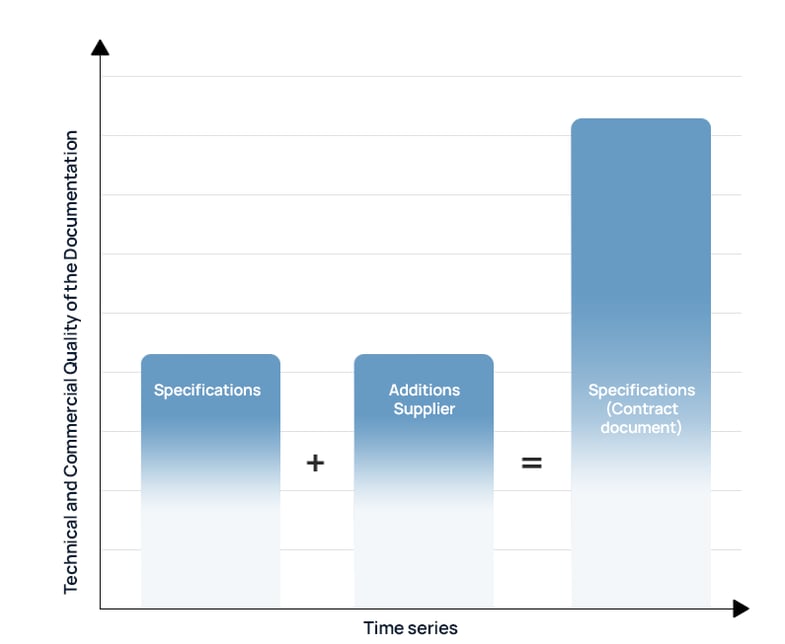 From Requirements Specification to Functional Specification — the enrichment is represented by the size of the area.
It is precisely defined here where standards are used and where custom development will be necessary. In the case of pure custom development, the scope of the programming deliverables should be defined precisely, since there are no existing software outputs to fall back on. Accuracy and precision in describing the expected results are essential to bring the project to a successful close.
Equally important is defining how the new software integrates with the existing IT system — the information exchange across interfaces with existing software or linked databases. The work involved in data cleansing, in extending master data and master data structures should also be described in a Functional Specification, along with requirements for the hardware, the network (performance and security), and data storage (the database). The requirements on master data in legacy systems — their quality and the migration into a new system — should not be underestimated.
Project closure: Our experience has shown that defining the acceptance procedure and quality management in the Functional Specification is both useful and worthwhile. It is not always straightforward, but it pays off — both buyer and supplier then know exactly when a deliverable can be accepted.
On the basis of the Functional Specification, the software vendor then issues an offer and subsequently a contract document. Ideally, the Functional Specification becomes a component of the purchase contract.
Requirements Specification versus Functional Specification
The Requirements Specification describes and specifies business goals, technical and process requirements, charts, tables, and — where possible — process flows. The Requirements Specification is then enriched by the software vendor with information on the capabilities of their solution, their methodology, the interfaces, and the project methodology, and is established as a joint document between client and vendor (the software house).
In this way, a Requirements Specification (the requirements catalog) becomes a Functional Specification with precise specifications.
On this basis, an offer can be made and later a contract drafted, with the Functional Specification as an essential component.
Our free downloadable whitepaper contains an infographic, "Requirements Specification versus Functional Specification", that summarises the differences and clarifies who is responsible for which document. It also makes the goals of the Requirements Specification and the Functional Specification clearly visible.
Trends 2026: What's shifting in the Requirements Specification right now
Anyone writing a Requirements Specification in 2026 the way they did in 2018 is producing a document that is already outdated by the time the contract is signed. Four shifts are reshaping the DACH mid-market this year. None of them is a question of fashion; all four are questions of negotiating power.
Four shifts in 2026 — overview
Trend 01
User stories instead of functions
Function lists protect the vendor. A process description protects the client.
Trend 02
E-invoicing requirement from 2025
XRechnung, ZUGFeRD, PEPPOL now belong in the Requirements Specification — otherwise vendors drop off the shortlist.
Trend 03
AI pattern recognition — with evidence
General language models check Requirements Specifications for contradictions. They do not replace consultant judgement.
Trend 04
Module roadmaps instead of function lists
30% of ERP projects fail due to unclear requirements. Module roadmaps close the gap.
1. Requirements become user stories — not function lists
The older discipline of ERP selection consisted of dumping hundreds of functions into an Excel spreadsheet and letting vendors tick them off. Today this approach mainly protects the vendor: ticking a function makes no commitment about how it interacts within a process. Modern Requirements Specifications work with user stories — descriptions of how a business process actually unfolds for the person performing it. That shifts the conversation with the software vendor away from the function and toward the process effect.
2. The e-invoicing mandate forces Requirements Specifications into interface depth
Since 1 January 2025, German B2B companies must be able to receive electronic invoices; the transition periods for sending them run through the end of 2026. This sounds like an IT detail — in the ERP selection, it is a strategic Requirements Specification chapter. Anyone failing to include XRechnung, ZUGFeRD, and PEPPOL as mandatory criteria pushes effort into implementation and operations. From our experience, these are the requirements that were a "nice to have" in 2022 and that, in 2026, drop the first vendors from the shortlist.
3. AI pattern recognition in requirement documents — with evidence, please
AI-powered tools can now check Requirements Specifications for contradictions, redundancies, and gaps. The temptation is great to also let AI write them directly. Caution is warranted here. A general language model — whether ChatGPT, Claude, or another — sees your input and its training data. It does not see your existing systems, your pain points, or the dynamics of your market. Anyone ignoring this gets a Requirements Specification that sounds good. And that holds up to nothing in the contract. We will return to this further down.
4. Function lists become module roadmaps
Three out of ten ERP projects fail, according to ERP Barometer 2024, due to unclear requirements. The most common trigger: the Requirements Specification describes what the software can do, instead of what the company will do over the next three years. Requirements Specifications in 2026 are therefore increasingly structured by module and value stream, with the target process and KPI described per module. That turns the Requirements Specification into a module roadmap that is harder to talk away in contract negotiations than any function list.
Requirements Specification in your industry: What we have solved
A Requirements Specification is never industry-neutral, even when the table of contents makes it look that way. Three industries where we have led particularly many selection projects illustrate where a document genuinely fails in the mid-market — and where it holds.
Retail & consumer goods
Outdoor manufacturers, sporting goods brands, and functional food companies face seasonal pressure and supply chain stress simultaneously. That fundamentally changes what an ERP Requirements Specification has to do.
Pain point: Requirements Specifications with hundreds of SKU requirements, but without supply chain logic. The document lists article variants, seasonality, and size grids, but forgets sourcing lead times, supplier minimum order quantities, and end-customer returns logic. Vendors then offer a standard ERP solution that maps SKUs but doesn't solve the actual bottleneck.
Solution from our practice: In a project with a German outdoor specialist — with whom we have worked for 15 years — we restructured the Requirements Specification along the value chain: sourcing, inventory, seasonal planning, omni-channel fulfillment, returns. Each module with target process, KPI, and interface requirement. We have applied comparable structures with an international sporting goods manufacturer and a functional food brand from the German-speaking region.
Lesson: In retail, a Requirements Specification structured along the value chain produces shorter negotiations with vendors and contracts that survive the season. Function lists won't win you the Christmas trade — module roadmaps will.
Have your retail Requirements Specification reviewed →
Plant & mechanical engineering
DACH mechanical engineering lives in the tension between series production and project work. Every order is potentially a service contract under § 631 of the German Civil Code. That logic must be visible in the Requirements Specification, otherwise it doesn't carry into the ERP contract with the software house either.
Pain point: Requirements Specifications mix series and project business. Vendors notice this in the workshop and position their standard modules for one and their customisation hours for the other. The result: project costs in implementation that could have been avoided in the Requirements Specification.
Solution from our practice: In the Requirements Specification, we draw a clean line between bill-of-materials management, variant configuration, and engineering change management. For each module, we describe how an engineering change moves through BoM, procurement, manufacturing, and service — including the interfaces to PLM and CAD systems. That gives the vendor a clear template to calibrate standard modules and extensions against.
Lesson: In mechanical engineering, separating series from project work in the Requirements Specification is not a detail. It is the foundation that allows the Functional Specification to function later as a service contract.
Have your mechanical engineering Requirements Specification reviewed →
Professional services
Academies, education providers, IT services firms, and consultancies do not sell a product. They sell capacity, qualification, and reliability. That is precisely what classical Requirements Specifications translate worst.
Pain point: The document focuses on master data and financial accounting, and neglects the resourcing model. A trainer is not a machine, a consultant is not a stock item. When the Requirements Specification fails to describe skill profiles, availability logic, and utilisation KPIs, the company ends up with an ERP solution that forces it into Excel shadow accounting. The added value disappears.
Solution from our practice: In a project with a multi-regional language academy, we rebuilt the Requirements Specification so that course management, trainer availability, location splits, and financial consolidation form one continuous module. With a passenger information system provider, we applied the same approach to cross-border procurement and service processes. The result in both cases: significantly less Excel shadow work after go-live.
Lesson: In services, the Requirements Specification that wins is the one that describes the skill and utilisation model with the same precision as an industrial Requirements Specification describes the bill of materials.
Have your professional services Requirements Specification reviewed →
Where the Requirements Specification wins the negotiation — and where SCOReX® wins the Requirements Specification
Most Requirements Specifications protect the vendor, not the client. That is rarely a matter of bad intent. It is because the document is written at the wrong resolution: too granular on functions, too coarse on processes, too short-sighted on time horizons.
That resolution is exactly where our consultants work with SCOReX®. SCOReX® is our proprietary AI-powered decision model. It is not the author of the Requirements Specification. The author remains the consultant you know and negotiate with. SCOReX® is the instrument we use to test every requirement against three dimensions before it goes into the document: against your own processes, against the pain points and systems from over 400 selection projects we have led, and against the likely development of the requirement over the next three years.
What our consultants do differently with SCOReX®
In a classical workshop, the quality of every individual requirement depends on the day's form of the participants. With SCOReX®, every formulated requirement immediately sits next to comparable requirements from earlier projects and next to the existing systems that the new solution must speak to. We see during the workshop where requirements conflict with each other, where they are redundant, and where gaps appear that a vendor would later use for customisation. The model structures and accelerates our consultants' judgement; it does not replace it.
Why not just use a general AI model?
A fair question — particularly because ChatGPT, Claude, and comparable language models can now produce decent-sounding Requirements Specification drafts. The clean answer is four lines and one consequence.
Our take: A general language model sees your prompt. SCOReX® sees your company. And every comparable ERP project we have led so far. This is not a tool contest. It is the question of whether your Requirements Specification holds up at the negotiating table or not.
What ends up in the document
A Requirements Specification produced with SCOReX® support looks at first glance like any other — table of contents, processes, interfaces, KPIs. At second glance, three things are missing that other Requirements Specifications contain: redundant function queries, internally contradictory requirements, and modules that have demonstrably no ROI in your industry. What you see instead is a module roadmap that a vendor can calibrate clearly. And that our consulting team will defend on your behalf if the vendor tries to talk it down.
30 minutes with Dr. Dreher
— free of charge, confidential, no sales pressure.
Bring your current Requirements Specification (or what you have of it), and you will get an honest assessment of where it holds and where it will cost you in the negotiation.
Book a meeting →
-
Next step: 30 minutes with Dr. Dreher
If you are currently facing an ERP selection or want an existing Requirements Specification reviewed, the fastest route is a 30-minute web meeting. You leave with three concrete points:
-
An assessment of your current Requirements Specification or selection situation along the module roadmap logic,
-
An honest read on where the document protects the vendor today rather than your company,
-
A clear next step — with or without further engagement with Dreher Consulting.
More than 400 led ERP selection processes from the DACH mid-market stand behind that assessment — and with them an experience a language model cannot have.
Further reading: ERP Functional Specification — really necessary for software selection? · ERP consulting and Requirements Specification · led selection projects.


Found this helpful? Let’s explore how these insights could benefit your business.
Click the Contact Us button to connect with me directly.
Requirements Spec
A vendor-written requirements spec protects the vendor - not you
Dreher reviews your requirements specification vendor-independently and shows where it won't hold in the contract.
Have your spec reviewed